
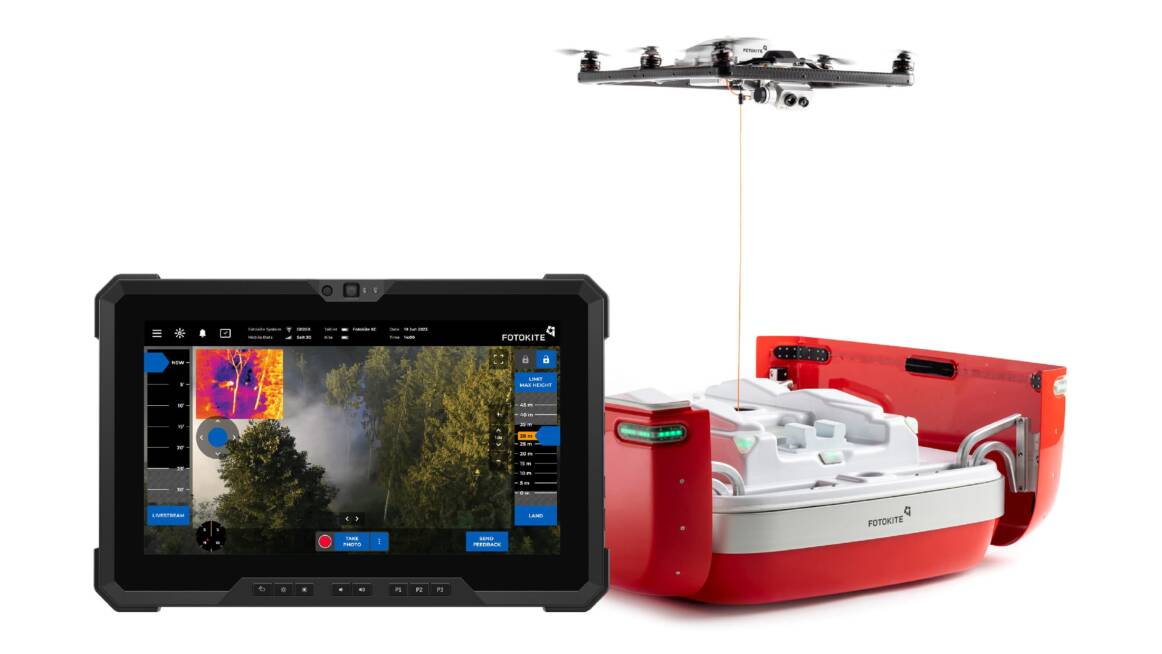
Emergency services increasingly rely on technology to support first responders, employing tools such as emergency dispatch software and early wildfire detection systems. Drones, frequently used in tactical intelligence and military surveillance, are now becoming more accessible for emergency scenarios like fires and search and rescue operations.
Fotokite, a company originating from Zurich with offices in Syracuse, New York, and Boulder, Colorado, is revolutionizing drone technology. They develop fully autonomous, reliable systems that provide essential overview information to firefighters and first responders, aiding them in managing complex, critical situations such as fires and volcanic monitoring.
Fotokite emerged from ETH University’s efforts to enable a quadcopter or multicopter to navigate using a tether, estimating its position based on the tether’s force vector. This innovation resulted in a fully autonomous flight system. Today, Fotokite serves customers in cities like Los Angeles, London, Paris, and Milan, and raised $11 million in Series B funding in April, bringing its total funding to over $26 million.
No piloting, GPS, or computer vision is necessary. Fotokite’s exploration of various commercial and consumer applications revealed their unique technology and approach to tethered drones offered substantial, long-term value to firefighters and public safety teams.
Fotokite systems are integrated into the top of fire trucks and public safety vehicles, allowing first responders to deploy drones quickly. Upon arrival at a scene, responders can activate the system from within their vehicle, and the drone is deployed autonomously within 15 seconds. No operator, no joysticks, all the hurdles is eliminated as well as the complications of using a drone that requires to focus on flying rather than responding.
The Fotokite drones fly autonomously, streaming thermal and regular video to emergency responders on the ground without the need for piloting, providing crucial information seamlessly.
Advantages of Tethered Drones
Tethered systems add safety and redundancy. For instance, tethered drones receive primary power from the ground vehicle. If the vehicle loses power, an onboard backup battery ensures the drone lands safely.
This GPS independence makes Fotokite drones ideal for urban areas where GPS signals can be unreliable.
Untethered drones often require a license or certification to operate legally in regions like Europe and the EU. Fotokite collaborated with lawmakers in the US and Europe to establish a new category for actively tethered UAS, which can be operated in zero-grid airspaces without a pilot’s license. This makes them accessible to a wider range of users, including volunteer firefighters, as only a small percentage of first responders are trained pilots.
Although tethered systems may initially be more expensive due to the need for ground stations and electronics, Fotokite mitigates these costs with lower operational expenses compared to untethered drones.
Tethered drones offer continuous power and real-time data transmission, bypassing the limitations of battery life and radio signals. Power is sent up the tether as well as data. The full video pipelines from both the thermal and regular video and all of the controls are handled over the actual tether cable itself.
This setup creates a wired connection between the drone and the ground station, allowing for robust data processing and transmission.
Fotokite’s technology represents a significant advancement in public safety, enabling firefighters and first responders to concentrate on saving lives.
Image source: Fotokite