
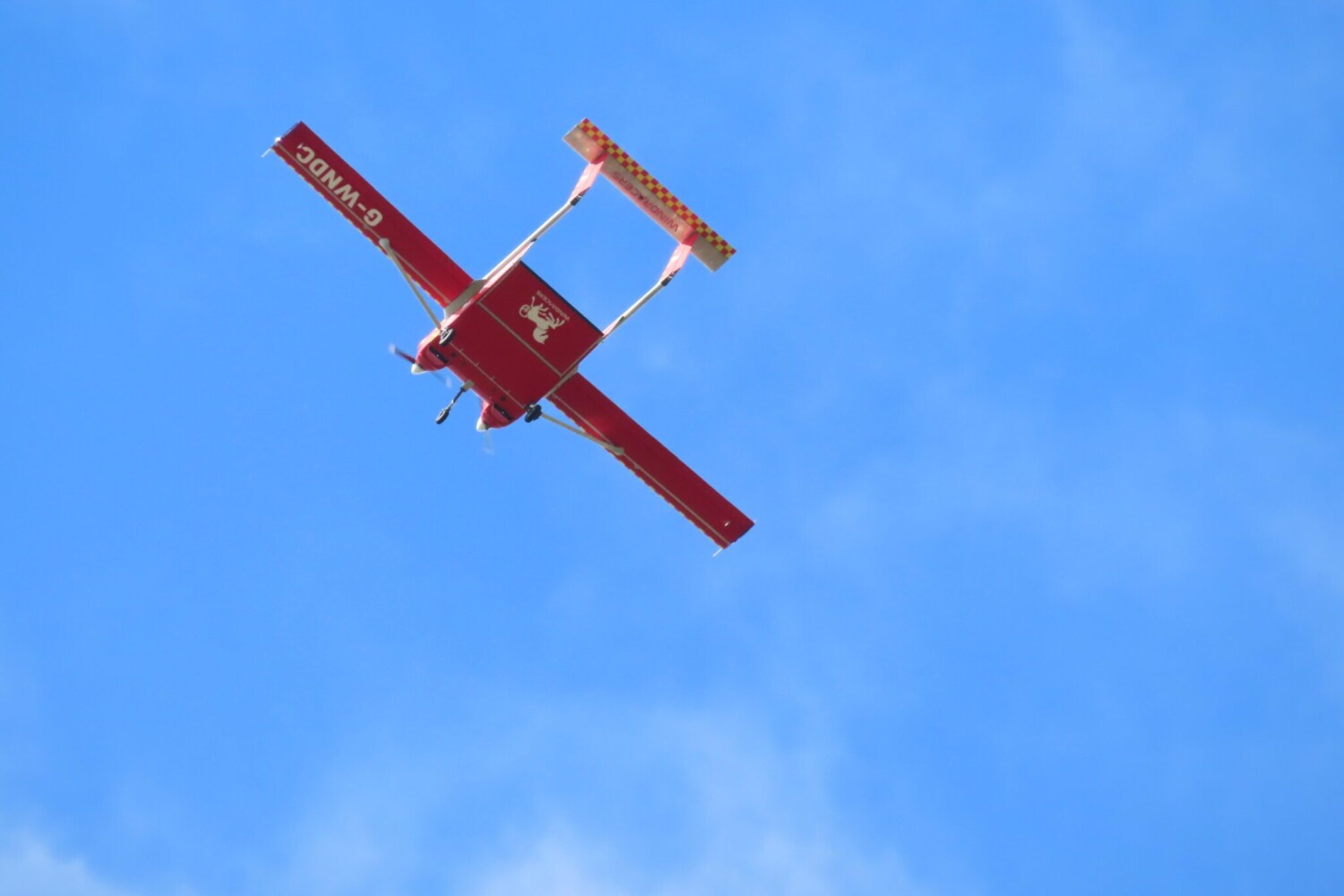
Windracers, a UK company specializing in autonomous cargo drones, has revealed that their Ultra UAV was recently put through its paces by Lancashire Fire and Rescue Service. The aim of the trial was to explore new, cost-effective methods for early wildfire intervention.
“The earlier we reach fires, the less harm they pose to firefighters, communities, infrastructure and the environment,” said Justin Johnston, Chief Fire Officer at Lancashire Fire and Rescue Service.
A press release highlighted that wildfires are increasingly frequent, expansive, and intense in the UK, driven by factors such as land-use changes, rising temperatures, droughts, and climate change. In 2022 alone, there were over 44,000 recorded wildfires, marking a 72% increase from the previous year. Lancashire Fire and Rescue Service, for instance, spent more than 41 days last year combating a wildfire that covered over 18 square kilometers (nearly 7 square miles). The Ultra drone offers a potential solution, capable of carrying over 100 kg (220 lbs) of fire-retardant chemicals and autonomously responding to emerging wildfire threats.
The drones, powered by AI technology developed at the University of Sheffield, utilize thermal and optical imaging to detect and assess fires. They then relay critical information to ground-based firefighting teams. With swarm technology designed by the University of Bristol, the drones can autonomously coordinate with each other to rapidly deploy fire suppressant chemicals, monitor the situation, and return to base, all under the oversight of fire and rescue teams.
Stephen Wright, Founder and Executive Chairman at Windracers, remarked, “This successful trial is the result of four years of R&D, involving some of the UK’s top experts in autonomous aviation, AI, and robotics to address one of society’s most pressing issues. We believe this cost-effective technology could be transformative.”
The trial, conducted over a week at Preddanack Airport in Cornwall, rigorously tested the Ultra drone’s autonomous fire detection and swarm capabilities. Alongside the Ultra, three smaller UAVs were also deployed. The press release stated that the drones successfully identified and approached multiple small, controlled fires, all closely monitored by fire and rescue teams. This trial marks a significant step forward in the development of wildfire prevention technology, which may be deployed by firefighters in the future, subject to regulatory approval.
Justin Johnston of Lancashire Fire and Rescue Service added, “The self-governing swarm of flying drones could help firefighters detect a wildfire earlier, while being able to locate the exact place of fire and summon other drones to control the fire before firefighters get to the scene. We are proud and delighted to be part of this trial, the first of its kind in the world, and have a say in technology that could greatly reduce the risk of wildfires.”
The project was funded by the Future Flight Challenge, an initiative of UK Research and Innovation, managed by Innovate UK. The project, titled “Protecting environments with unmanned aerial vehicle swarms,” was one of 17 that shared £73 million in funding aimed at developing integrated aviation systems and innovative vehicle technologies.
Sabine Hauert, Professor of Swarm Engineering at the University of Bristol, commented, “Finding and tackling wildfires before they become a problem requires many robots to work together as a swarm,” said Sabine Hauert, Professor of Swarm Engineering at University of Bristol. “We’ve spoken to firefighters around the world to design a swarm that is useful and easy for them to operate. It was great to see this technology being tested for the first time.”
Image source: Windracers